CategoriesReviews

Level Up Your Camping with a Portable Air Conditioner: We Tested The BougeRV AC Outdoors!

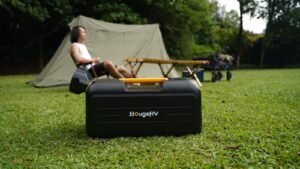
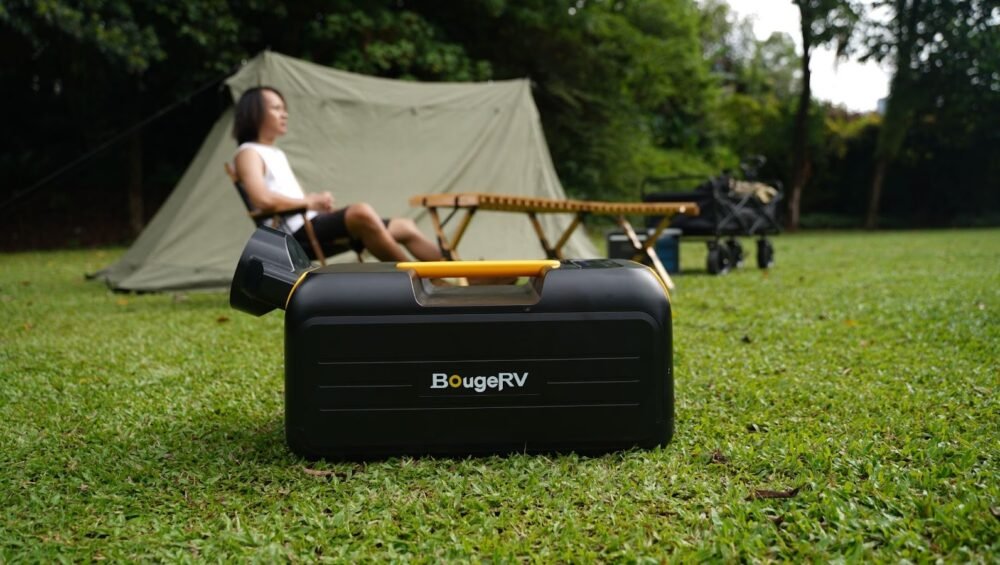
Having already tested the BougeRV indoors, we wanted to see how it performed in a real outdoor setting. Over the weekend, we took it on a camping trip and tested in two setups: placed inside the tent with the exhaust vented out, and placed outside the tent directing cool air in. This allowed us to compare how effectively it cooled a small enclosed space and how different the experience felt in an actual campsite environment. Here’s what we found:

Setup & Conditions
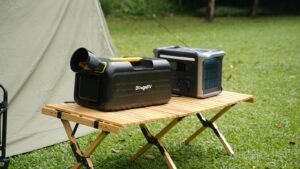
For this outdoor test, we brought along an Anker 757 Power Station that has a battery capacity of 1229Wh, 1500W output with a 2400W surge and fast-charging support as the power source to give us reliable power supply in the wilderness..

The tent we used fit up to 2 people, measuring 195 × 150 × 130 cm. While the space was compact,  the interior heated up quickly under the hot sun and created the perfect scenario to test the limits of the BougeRV outdoors.

We first tested the AC outside the tent before moving it inside to compare the cooling difference. With daytime temperatures sitting in the mid-30 °C range and moderate humidity — basically a typical hot camping afternoon — it gave us a realistic and demanding environment to see how well a portable AC could perform outdoors.

Cooling Performance in the Tent

1. Outside the Tent
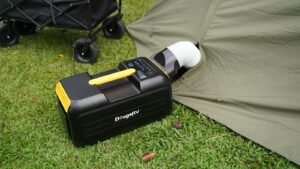
With the BougeRV positioned outside the tent, we directed the cool air using the flexible exhaust hose into the tent, while expelling hot air to the open space. During daytime testing, the cool air made the tent noticeably more comfortable within 15 minutes. The interior temperature dropped from roughly 30 °C to 27 °C. By the 30-minute mark, it reached around 24 °C, providing a refreshing, calmer environment despite the heat outside.

Running the unit on 22°C of cooling mode outside slowed the temperature drop slightly — it took about 30 minutes to achieve a ~6 °C reduction — but it significantly extended battery life, making it more practical for long camping sessions.

2. Inside the Tent
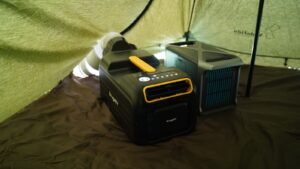
With the outside test done, we moved it inside the tent to compare the cooling efficiency. When BougeRV is placed inside, the hot-air outlet is connected to the flexible exhaust, routed hot air through a partially unzipped door flap. Within 15 minutes, the temperature fell from ~30 °C to 27 °C, and by 30 minutes it reached ~24 °C, similar to the outdoor setup.

We noticed that keeping the tent flap as closed as possible helped maximize the cooling efficiency. The small enclosed space meant the cooling effect was more immediate while opening it too much allowed warm outside air to mix in, slowing the drop in temperature.

3. Night-time Performance

At night, when outdoor temperatures eased, the BougeRV kept the tent consistently comfortable, maintaining around 23°C. Placing the unit inside provided more direct cooling while also helping to protect it from dew or condensation that can form overnight. This setup ensured a steady airflow that made sleeping or relaxing in the tent far more pleasant compared to just having a small fan.

Although the unit occupies a small portion of floor space, it remains manageable even in a compact 2 person tent. One tip is to position the aircon nearer to the corners where there is usually some empty space. In sleeping mode, the AC runs quietly, producing a gentle breeze that doesn’t disturb rest while keeping the tent air calm and refreshing throughout the night.

Noise and Usability Outdoors
The noise level was manageable — you’ll hear the airflow and compressor in cooling mode, but it isn’t distracting, especially with the tent fabric helping to dampen sound. In sleeping and fan modes, the noise dropped significantly to 50dB (similar to the noise level in a library), making it easy to relax, read, or sleep without disturbance.

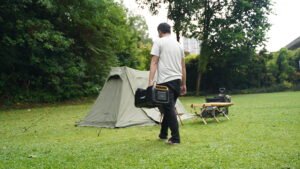
Portability was another strong point. The unit and hose are compact enough to handle comfortably, and the build feels solid yet not overly bulky for outdoor use. Since we were also bringing along the power station, we used a trolley to transport everything to the campsite, which made the setup much easier and less physically demanding. Overall, the BougeRV balances portability and practicality well, making it a convenient companion for outdoor trips without compromising on performance.

Power Usage and Runtime
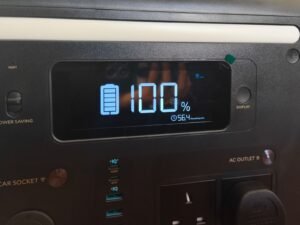
We tracked the power output closely to understand how long each mode realistically lasts on a 1229Wh power station. On fan mode, the BougeRV drew roughly 20–22 W, which translates to a theoretical runtime of about 56–57 hours. For sleeping mode, the power draw increased slightly to around 23–24 W, giving an expected runtime of roughly 52–53 hours. High cooling mode, however, pulls a significantly larger load—about 470–480 W depending on the temperature set—which would theoretically allow 2–2.6 hours of operation.

In our real-world test, we ran the BougeRV until the power station dropped by about 20–25% of its charge. Extrapolating from that partial usage, we estimate the full runtime would be roughly 50–55 hours on fan mode, around 45–51 hours on sleeping mode, and just under 2.5 hours on high cooling mode. Environmental factors like ambient temperature and tent insulation could slightly reduce these numbers in real-world scenarios, but these calculations give a realistic expectation for extended use when relying on a high-capacity portable power station.

Tips and Observations
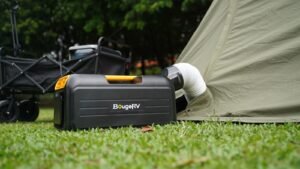
After spending two days using the BougeRV outdoors, here are some tips that made a noticeable difference:

  • Power budgeting: With the 1229 Wh power station, you’ve got enough juice for an overnight (or near-overnight) in moderate ambient conditions if you run the AC on medium/low mode. But if daytime temps hit 37-40 °C, plan for a shorter runtime, bring a larger power pack or consider solar charging during the day.
  • Vent/exhaust placement matters: Ensure the exhaust hose vents to open air, not trapped between tent flaps — otherwise warm‐air recirculation will reduce performance.
  • Tent seal matters: Keeping the tent entrance mostly zipped and the fabric taut improved cooling efficiency.
  • Pre-cool tactic: If possible, switch on the unit about 10 minutes before entering the tent so it’s already cool when you settle in.
  • Watch water condensation: When using outdoors, we noticed a little condensation around the hose/exhaust area (likely due to higher humidity). Keep a small tray or absorbent pad underneath if using on softer ground.
  • Temperature drop realistic: Expect a drop of ~5–8 °C in a small tent under moderate outdoor heat within 20–30 minutes. Don’t expect to go from 35 °C to 20 °C when the unit is undersized for space or extreme heat.

Final Verdict
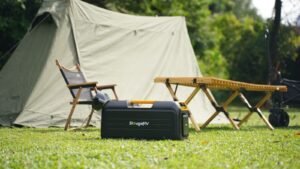
If you camp in small tents, cabins, or gazebos and already have a reliable portable power station, the BougeRV Portable AC is genuinely a solid cooling companion. It delivers noticeable comfort without complicated setup and runs long enough for evening and nighttime use. It delivered noticeable comfort, ran long enough for most evening/night use, and didn’t require any special setup beyond hooking up the hose and power.
It’s not a miracle cooler for large tents or full-sun exposed structures — but for smaller outdoor spaces where you spend time resting, reading or sleeping, it brings the kind of “home-air-conditioner” feel you don’t often see in portable outdoor units.If your camping gear budget allows and you want to elevate your comfort rather than rough it out, the BougeRV outdoors wins points. Just plan your power, venting and space accordingly.
Verdict: ⭐️⭐️⭐️⭐️☆ (4/5) — Great for small tents or cabins, keeping your space cool and comfortable without complicated setup.
See how it performed in our first impression review and indoor test, then pre-order now at RM1299 to bring portable cooling to your next camping trip.
CategoriesReviews

A Compact AC That Works Everywhere? My Real-World Test of the BougeRV Portable Air Conditioner

After unboxing the BougeRV Portable Air Conditioner, I was going in with an open mind – the online reviews looked good, marketing videos seemed legit and initial tests were true to what it claimed. It looked neat and compact, sturdy and sounded like a workhorse — but as product reviewers, we have to check against the spec sheet and marketing claims. I wanted to see if this little unit could actually handle Malaysia’s kind of heat and humidity, not just survive in standard lab conditions.

So I decided to test it indoors around the house where people may not have an air conditioning installed. I tested in three different spots: a study/work corner, a storage room/garage, and a small (usually spare) bedroom. Here’s how it went down:

Study/Work Space Test — Keeping Me Cool During the Afternoon Heat

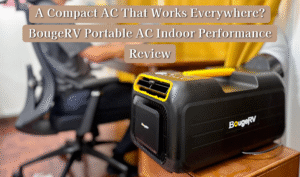
My work corner that is beside the window gets warm after lunch during sunny days. I placed the BougeRV about half-a-metre away and switched it to Cooling Mode at 20 degrees celsius with medium fan speed. Within minutes, I could actually feel the difference — not that icy kind of cold, but a softer, more natural breeze that made it easier to focus as my immediate area’s temperature cooled.

I also felt a bit of a dehumidifying effect, which was evident from the humidifier indicator which dropped from 72% to 65%. Noise wise, it was pretty quiet — the hum of the BougeRV was somewhere around 55–60 dB as per the sound testing app — noticeable if you listen for it, but never distracting with sudden jolts of sounds.

The app control, though not essential to the cooling experience, was a nice touch too. I could tweak the temperature or timer right from my desk — no need to get up mid-flow. For small home offices or study spaces, I’d say this unit is more than enough to stay comfortable through long work sessions. 

One thing to note is the provision of a hot air outlet near a window to expel the hot air. For my test, I used the flexible hose and pointed the open end to the bottom corner of the window. For long term usage, this will likely be a fixed position for the pipe, and this opening can be DIY-ed with a 3D-printer or an off the shelf accessory. 

Store Room/ Garage Test — Beating Humidity and That Musty Smell 

This is a less thought of use case – my storage room. We don’t think of it much, but when we are inside of it long enough for packing or searching for things, it becomes a situation where comfort makes a big difference. Store rooms are usually tiny-ish, packed with boxes, and always feels like a sauna. For this test, I switched to Max Mode at 18°C and directed the hot air outside using the flexible hose.

By the 3rd-minute mark with the power churn, I could already tell the air was lighter and cooler — not that heavy, sticky kind anymore. The packing or ‘treasure hunt’ experience was immediately elevated to an enjoyable one without the sweat. 

One of the biggest surprises was that the air did not smell musty after a while. The dual-hose setup seemed to help cycle out stale air while bringing in fresher air. I definitely did not expect that level of freshness from such a small machine.

By extension, this can be useful in bigger areas like a garage where we do not spend time there frequently but when we do spend time, it could be more than 20-30mins at a time. 

Spare (small) Bedroom Test — Overnight Cooling for Better Sleep

Finally, I brought it into a small bedroom for an overnight run. I set it to Sleep Mode at 19 °C, pointed the BougeRV to the bed and placed the outlet vent towards the window, and went to bed.

The BougeRV being a small compact air conditioning unit, managed to push cool air out consistently without the loud noise. Its cooling technology mimics an aircon cooling unit and condenser unit efficiently without the hassle of running the water to an outlet. Not surprisingly, the sound was quiet in this mode at around 50 decibels which is akin to a library. The air felt soft — not a harsh, cold blast that makes you reach for a blanket halfway through the night. It was comfortable on the cooling front and the noise test.

By morning, the room still felt cool and comfortable, and the air wasn’t dry, the humidity measure recorded 65%. 

If you’re renting or living in an apartment without built-in air-con, this is a really practical solution for your warm nights. No messy installation, no water issues, no drilling, just plug in, find an outlet for the hot air and sleep cool throughout the night.

Final Thoughts — Small Machine, Big Impact

After using it around the house for a few days, I’d say the BougeRV Portable Air Conditioner is more than just a “portable AC.” It’s like an all-in-one cooling device — cooling, dehumidifying, and even freshening the air in a local area without disturbing the humans in the room.

It’s light enough (17kg) and balanced well with a handle to move around when needed, but once you set it up, it works quietly and consistently. I love that it doesn’t need any permanent installation except for the positioning of the hot air outlet, and the energy use seems quite decent for what it does (400W). I do wish it had a longer power plug cord, so that it can be powered to a power source more neatly without extension cables.  

Extending the concept of localized cooling, it can cool areas in bigger rooms where the traditional wall mounted air conditioning units may not be able to reach. But with a few of the BougeRV around, it is able to help cool it down. 

Next, I’m planning to take it outdoors for a camping test — that’ll really show how “portable” it is and how long it can last with a portable power station. But indoors? It’s already proven itself. Compact, quiet, and reliable — this little guy fits perfectly into real homes who need portable cooling. 

Verdict: ⭐️⭐️⭐️⭐️☆ (4.5/5) — Great for small areas in humid weather. Would highly recommend it if you need portable cooling without the hassle of installing a full air-con system and drainage system.

Curious how our journey started? Check out our first impression review to see our early thoughts before we tested it indoors. Pre-order now at RM1299 and experience how this compact air conditioner can fit perfectly into your home.